
Home
I direct my gaze at some internal politics that have had me bothered.

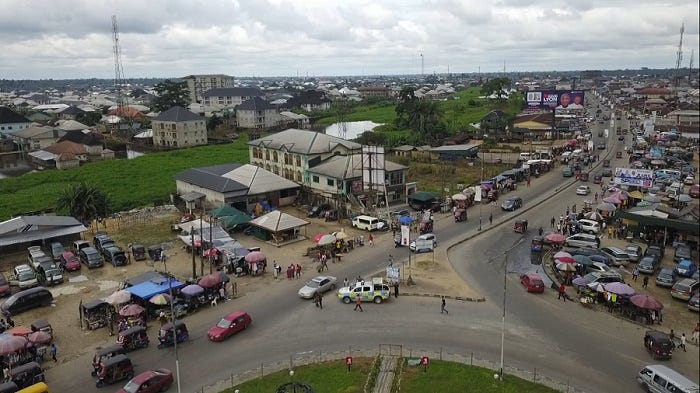
It’s the second day of the new year. Two more days and I will be leaving my family in Yenagoa, and heading back to Uyo where I live in a cramped room but still get to be visited by the love of my life every thrice in a while. I figure that before leaving I should write about home, focus my gaze into internal politics, and feed you some lore about where I am from.
On the 12th of December, I left Uyo Akwa Ibom State for my family house in Yenagoa Bayelsa State. For almost a year I had not seen my family, and I had missed them immensely. As for Bayelsa and Yenagoa in particular, anyone who had ever felt nostalgia must recognize what nostalgia does to a person. One could literally have crawled out from the mud, the gutter—the trenches as they call—and still miss the place, and conjure gold tinted images that mask the past in such grandeur when they think of it.
When I was in Uyo, the nostalgia I had of the place made me envision it with rose tinted hues. I managed to forget the bag of degeneracy and debauchery that was that place. I came back to find that the calm neighborhood my parents had moved into three to years ago, now housed cultists, who in Bayelsa fashion, are very open with it. I felt like I had made a mistake
I told my brother that I felt a large part of the degeneracy of the Delta is due to the ethnic pluralism which creates a nihilistic atmosphere that leaves most people falling into their instincts.
Now everytime I get home, I try my best to have conversations with my siblings as well as my mother. With my mother, I talk about faith, life, and fate. With my brothers I talk about politics, the future, money, anime, and the natural world. With my younger sister, I talk about social issues and music. The most interesting conversations I had at home during the short visit, was with my mother and younger sister.
Of my younger sister I learnt was now a feminist. This was a riveting news to me because for two years now I’ve been a very vocal critic of feminist politics. And it was such a funny issue because of everything we talked, we agreed on 90%.
The moment of escalation was when we talked about Chimamanda Adichie, and she told me while cackling, about how the woman was being dragged for calling some feminists angry, to which she added that feminists had every right to be angry because womenfolk were going through a lot of misfortune and being angry about it was in no way a comparison.
And I really do not care for Chimamanda. I just made a comment of how I think a lot of feminists are just angry, and I got turned on voraciously for saying that, thus an argument ensued. The argument was literally just my sister shouting at the top of her voice in typical grievance style, and me trying to explain myself.
I asked her if she thought men and women being equal would stop the “femicide” as she called it and I still wasn’t given a proper reply. At the end, I told her men and women are not equal, which she thought of as a very awful thing to say without asking me to explain what I meant as equal, and who was greater than who—which is a very silly reduction of the matter.
Anyway, my sister and much other members of my family are shape rotators and are not abstract wordcels like myself, so arguments from me are treated to be too airy. My sister is an architect, and while she is smart in her own way, she got lost in much of the arguments I made to her. But I am not devoting this letter to that argument. My main issue is with the conversation I had with my mom.
My mother just lost her brother. He was a very politically vibrant man that was involved in a host of political movements in the past. But adding to that, he was also irreligious. Ever since his funeral, my mom has been going down a nihilistic phase which she told me was triggered when she saw the face of her deceased brother as he laid in the casket.
In her words, she said, it got her into wondering how despite all his intelligence, wealth, and social standing, he was still not able to beat death. And she could only wonder where he is right now. She was disturbed by the thought that her brother might be in hell.
She said that it became clear to her that the chief aim of man is to follow the commandments of God and leave all worldly things for the people of this world. For only they should struggle with the perishable material realm.
Noticing how much I talk about politics, both on the local and international level, she asked me what I was so bothered about with it when the only thing I really needed to do is to serve God and work hard only for the benefit of myself and family? I told her that as a Christian—which I am not—following God’s commandment to Adam to be fruitful and multiply in the world should already be enough reason to make the world a better place. To which she became quiet in a moment of sober reflection.
The most interesting thing about my uncle was that he was involved in a number of political organizations, including the most interesting one, a movement in Bayelsa called the Oguan people’s Movement. It has the potential to be the most disruptive political movement in Bayelsa for reasons I will state below.
My family moved to Bayelsa from Portharcourt three months after I was born. This was a few years after the creation of the state, the period where Milltary rule gave way for Civilian rule under the leadership of Obasanjo. Bayelsa was about to get its first Civilian Governor and Deputy—a man my father worked for as a driver. I was born with the rebirth of Democracy in my country. And I have met only a few people that have been as Anti Democratic as I am.
We would live in Bayelsa until the present. Most of us still live there. Staying away was some sort of aberration that broke a stereotype that has long plagued people where I am from. My parents are both from extreme minority groups who have only been able survive in our political climate by presenting themselves as a sub-group of the Ijaw people, the majority of my state. My mother is from the incredibly minute Epie-Atissa ethnic group, and my father from the Zarama-Engenne ethnic group. Both groups are related by the fact that they both share a common story of migrating from ancient Benin City to the present day lands in Yenagoa. They both speak variants of Edoid languages that corroborate the claim. These groups are in present time, referred to more commonly as the Oguan people.
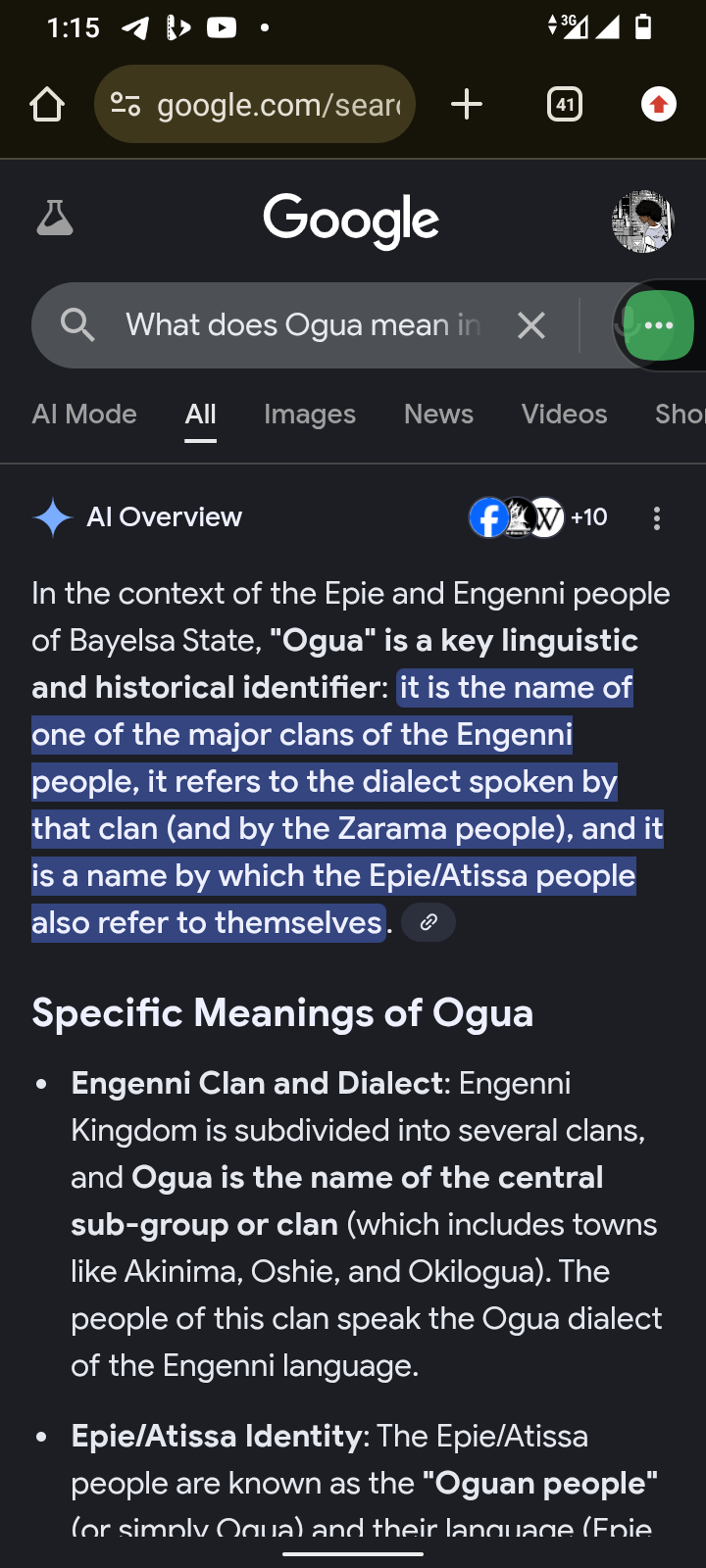
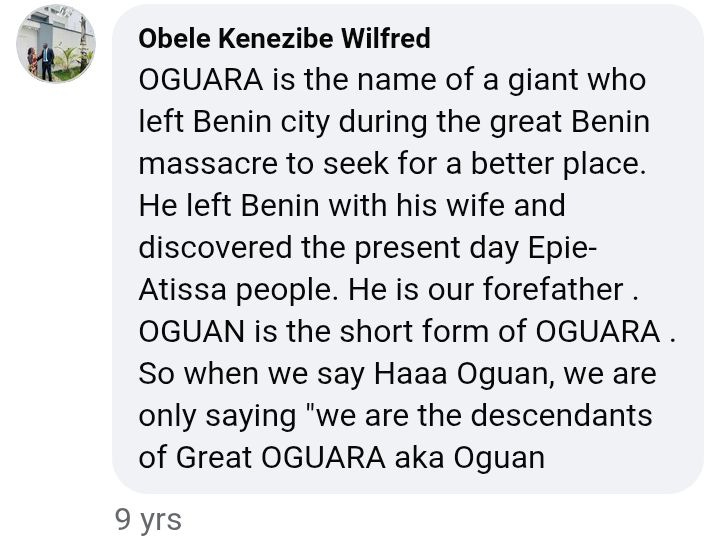
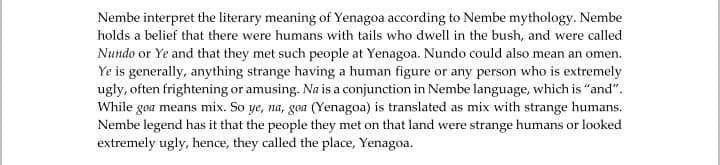
If you wonder why there is an hyphen between those names, then it is a good thing I have an answer for it. There is a sort of clannishness that plagues people of the Niger Delta. It is not rugged individualism, but a very primitive instinct to atomize.
The groups I mentioned where my family emanates from have everything to do with each other. They are all kin, with a shared traditional origin and a language to prove it, but they’ve all been balkanized and chosen to remain so due to a lack of agency.
The Epie and Atissa speak the same language with just slight variations, with the Atissa variants sounding closer to Ijaw in tone and accent the farther down to the south you go. The people of Epie, where I have maternal origins, sound more closer to the other Edoid variants and languages the further north one goes. The people of Zarama, my paternal origins, speak nothing so different from the Engenni of River’s State, but have chosen to keep to their own clannish identity and not identify with their kin. The languages of Engenni and Epie are mutually intelligible to a high degree, that it is funny how in the broader context of it all, they don’t claim more unity. More of this will be touched further down the line.
The political history behind this is shady at worst, and obscure at best. But it’s been widely agreed between various circles that this the balkanization is because of an old rivalry between the Nembe and Kalabari—two of the most of influential and elite Ijaw clans who competed for lands and trade routes among themselves. These two groups are elite more so because they are among the first groups to make contact with Europeans and absorb European culture. Till date the Nembe still has considerable political influence over the affairs of Bayelsa, as much as the Kalabari has in River’s State. Noted persons from these groups are Ben Murray Bruce—Senator and C.E.O of Silver Bird Entertainment—and Timipre Silvia—Former Governor and Minister of Petroleum(also being suspected of orchestrating a failed coup on the present governor of the state)—both from Nembe. On the Kalabari side, we have Lulu Briggs and the Briggs Family.
Between 1862 and 1872 both clans fought over the markets old Engenni land and trade routes. At Engenni land is the mouth of the Orashi river that further flows down the Delta and towards the Atlantic ocean. Slaves, Palm Oil, and Palm Kernels, were traded there. To settle the disputes between both parties the British had to act as a peace maker. The Nembe took the Left side—West of the Orashi river, and all the trade routes and markets that lay there. The Kalabari had to take what was left at the right side, the East. This was the only means to broker peace.
This story is also conjured as a means to explain why large swathes of Engenni land was never carved into Bayelsa during its creation. Many leaders thought it would be best to keep the Eastern Engenni lands out of Bayelsa. This left Zarama, my paternal hometown cut away from the rest of its kin, under the territory of Bayelsa. Today it calls itself its own ethnic group, which I think is silly. It is an odd ball, and has only managed to alienate itself from everyone else.
One would have noticed how much that story leaves very little space for agency among my ethnic people. Surely, it does. Do not forget, much of Nigeria is basically tailored after what some old men wrote and did years ago.
When Bayelsa was created, Yenagoa, the land of the Epie-Atissa, became a state capital, and set the stage for more alienation of the Epie- Atissa from their ethnic kin. The Oguan Movement is a nationalistic movement whose aim is the unity of all Oguan groups, to further more representation in state and federal politics.
This is dangerous to the politics of Bayelsa because, the state was partly carved out due to the demands of Ijaw Nationalists who wanted a homogeneous Ijaw State in order to have further control of their resources. Bayelsa was supposed to be that Ijaw State. But Bayelsa, is not, and has never been an homogenous state. Surely the Ijaws are the majority but in the territory refered to as Bayelsa, exist other identities with languages and origins different from that of the Ijaw.
Not to make a mistake, in recent time, these differences are being curtailed due more so to rapid modernization than any cultural or ethnic assimilation; meaning that the people of Bayelsa are increasingly becoming more “Westernized” than they are being “Ijoized, although one must also acknowledged that this “Westernization” is occurring more so on the minorities than on the Ijaw majority.
The Capital city of Bayelsa, is basically on Oguan Land. This phenomenon brought about rapid modernization to the Epie-Atissa people, which the they were ill prepared for. The land was all of a sudden filled with strangers who do not really like the Epie-Atissa people and view them as vermin or inferior savages who only got lucky to host the state capital.
It’s been twenty nine years since the creation of Bayelsa and the resentment still persists, although in lower levels than what it was in the beginning, due to the fact that the natives of Yenagoa, apart from language and a few behavioural idiosyncrasies, are not so different from majority Ijaw and the other ethnic identities who have come to call Yenagoa home. Still several Ijaws look at the Epie-Atissa as some sort of unnatural “Other” that doesn’t belong in Bayelsa or have the rights to share in the benefits of the state.
To cover this up, the Epie-Atissa have adorned themselves in the robes of the majority and call themselves Ijaw, to convince themselves that they are indeed kin with these people who should no doubt be seen as mere invaders armed with government legislation to take over their lands and outbreed them, replacing their identity.
The Epie-Atissa are not the only ethnic minorities in Bayelsa who face these problems. The Ogbia does as well. As much as the Isoko-Urhobo, and the other Igboid and Edoid groups in the state. Yet, for the Epie- Atissa, the case is much more worse, as their entire culture is rooted in the little local government of Yenagoa.
It’s not as though the government of Bayelsa and Ijaw propaganda personnels have not tried to mitigate this, by continuously preaching and writing of how all the major ethnic identities of Bayelsa, are still just sub-groups of the greater Ijaw identity. I have agreed with this at one point in my life, and indeed I would still agree to it, as the other choice of the matter—the promotion of Oguan Nationalism against the Ijaw Nationalism seems a very strenuous thing to do, and ethnic jingoism is very low in my priority right now.
I also consider it quite dangerous because the Oguan would have to wrestle Yenagoa out of the grip of the Ijaw, and that is quite impossible in the present arrangements of the state, except of course there will come a revision of state boundary that would put the Engenni and Degema in Bayelsa. Apart from the fact that this would automatically make Burna Boy Bayelsan, it would go against the interest of Rivers’ State in the oil fields of the Engenni land.
As for Bayelsa and the Ijaw Hegemony, there would of course come the question of whether or not they would risk an Oguan unity, for more oil reserves. A trade between the material and the spiritual. Which way, Ijaw man?
That question should be for me. One of my long term visions is a more united Niger Delta and the secession of that from the Nigerian State. I want to be more so a good Niger Deltan than a good Oguan or Ijaw. At first I had thought that a unity of the Ijaw and all the closely related groups who spoke quite different languages, was ideal. But now I think that is impossible and would be a cause for more friction. We would be leaving a spacious Nigeria for a cramped Nigeria. In the community of nations I view my ideal of the Niger Delta Republic to be, the Oguans must have their own autonomous region.
So you see the question infact, is not, which way Ijaw man. It should be correctly put as which way, Vogel?
Insightful and raw. Just my cup of tea, my friend.